|
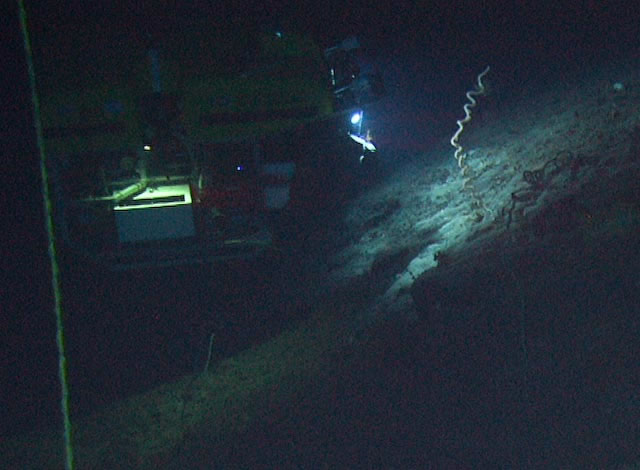
| The ROV Hercules is manuveured in front of a bamboo coral whip in preparation for sampling, at 1560 meters depth on Balanus Seamount. |
Because they live so deep, and often in rugged topography, deep-sea corals are a challenge to observe and sample. Ideally, one has access to the latest oceanographic technologies, including submersibles (mini-submarines) and remotely-operated vehicles (ROVs). These tools allow us to record high-definition video and still images (how most of the images shown on these pages were taken) of deep-sea communities and precisely sample individual colonies or branches of those colonies. We use the samples for species identification, genetics and reproductive studies.
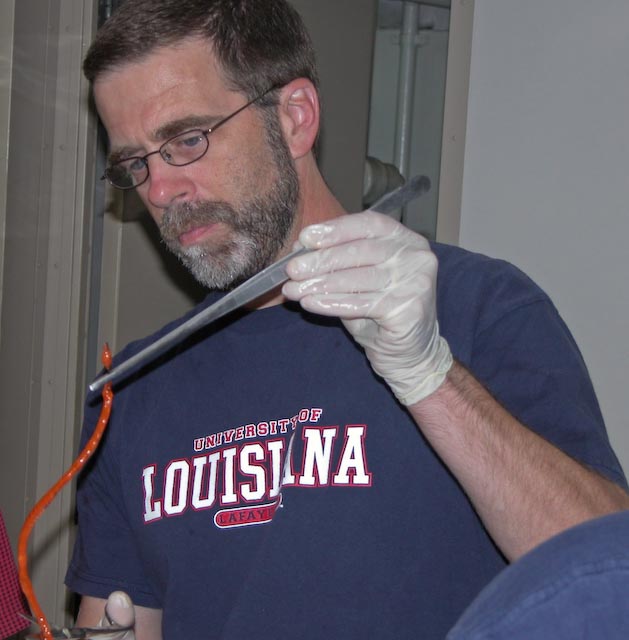
Sub-sampling a portion of a deep-sea black coral whip (Stichopathes sp.) on board the R/V Ronald H. Brown shortly after recovery of the ROV to the deck. (Image copyright of the Mountains in the Sea Research Team; IFE; and NOAA) |
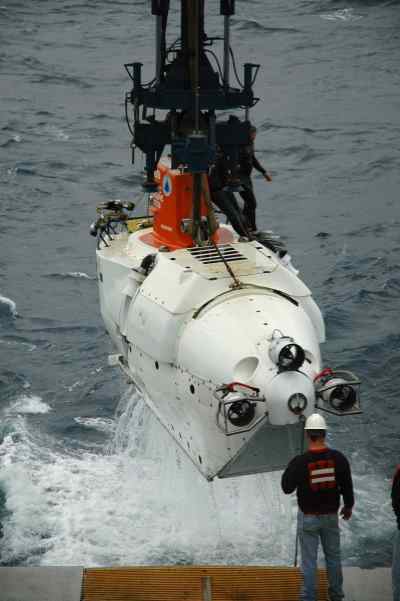
The submersible, or "Human-Occupied Vehicle" (HOV), Alvin being recovered after a deep-sea coral dive on the New England Seamounts. (Image copyright of the Mountains in the Sea Research Team; WHOI; and NOAA) |
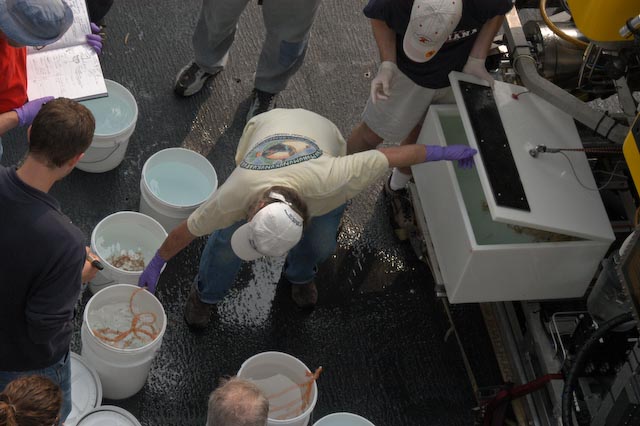
Following any of our deep-sea coral dives, we quickly sort coral samples into pre-labeled, pre-cooled buckets of seawater; these are then kept cold until we can process them in an orderly fashion over the next few hours. Here, Dr. Les Watling (University of Hawaii) transfers a bamboo coral from the ROV Hercules shortly after its recovery to the deck of the R/V Ronald H. Brown. (Image copyright of the Mountains in the Sea Research Team; IFE; and NOAA)
Site Map |