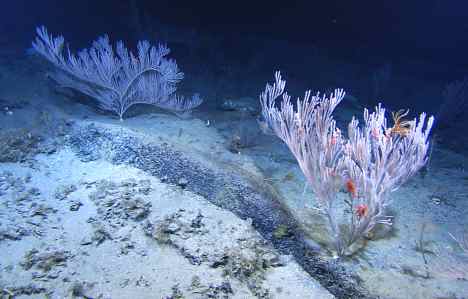
Primnoid octocorals aligned atop a small ridge at 1430 meters depth on Manning Seamount. (Image copyright of the Mountains in the Sea Research Team; IFE; and NOAA)
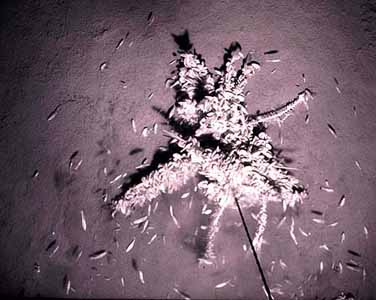
Amphipods (Hirondellea gigas) swarm over mackerel, deployed as bait, stripping away the flesh down to bone, at 9605 meters depth in the Philippine Trench. For more on my work in this system, see France, 1993. (Photo courtesy of Robert Hessler, SIO)
The primary focus of my current research is deep-sea coral. Octocorals (e.g., sea fans and sea whips) and black corals are relatively common in the cold waters of the deep sea, particularly where hard substrates rise from the bottom and current speeds are greater. My ultimate goal is to measure dispersal among populations of corals living on seamounts (underwater mountains). Our studies revealed that a commonly used molecular marker (mitochondrial DNA) shows very low levels of variability within and between octocoral species (see France et al. 1996, France & Hoover 2001, France & Hoover 2002), and thus cannot be used to measure dispersal. One explanation for the low levels of variation observed is a reduced mutation rate caused by a functional mismatch repair gene (msh1) present in the mitochondrial genome. A mitochondrial mismatch repair gene had previously been reported in only three species of octocorals (Beagley et al., 1995, Progress in Cell Research, 5: 149-153). We expanded the search for msh1 and to date it has been found in all octocoral species examined (>100 species)(e.g., France & Hoover 2001, Sanchez et al. 2003), including representatives from the three major clades found in Berntson et al.'s (2000) nuclear 18S phylogeny of the subclass Octocorallia. We have sequenced the entire gene (approx. 3000 bp) from a dozen species to characterize levels of DNA and amino acid sequence variation at multiple taxonomic levels. These analyses will allow us to test the utility of this gene as a molecular marker, and may help to help determine if the gene is functional.
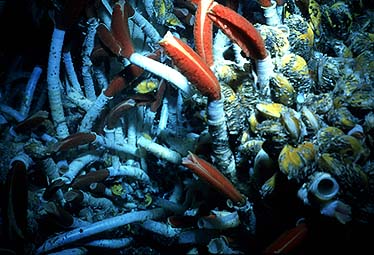
Vestimentiferan tube worms (Riftia pachyptila) and mussels (Bathymodiolus thermopolis) at 2470 meters depth in the Rose Garden hydrothermal vent, Galapagos Rift. For more on my work in this system, see France et al., 1992. (Photo courtesy of Robert Hessler, SIO)
Other research projects:
- molecular systematics of Anthozoa (Cnidaria)
- use of museum collections for DNA sequence analysis, including formalin-fixed specimens
- hydrothermal vent amphipod evolution; includes studies of dispersal and taxonomy
- distribution and dispersal of the deep-sea cosmopolitan amphipod Eurythenes gryllus
See my publications for more information
 Research funding provided by the National Science Foundation.